
By Dan Krueger
Let me begin by dividing the patent pool into three segments: (1) patents that you alone can use; (2) patents you can use but not exclude others from using (e.g., public domain or nonexclusive license); and (3) patents you can’t use.
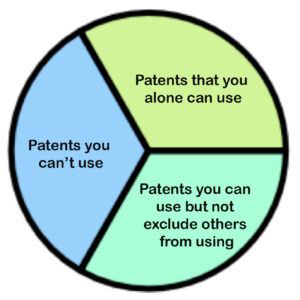
Roles in Innovation for Patents You Alone Can Use
I. Providing a barrier to competition
Patents are intended to create a safe space for new ideas to be developed and commercialized, but in practice are often ineffective due to territorial limitations, claim scope issues, difficulty of detecting infringement, enforcement costs, etc.
II. Marketing to customers
However insubstantial the protection, the presence of a patent protection notice on a product or in a sales brochure does provide at least an arguable distinction relative to the competition.
III. Providing assets to attract investors
Patents are salable and collateralizable assets that may reduce perceived risk for investors, enhancing the likelihood and amount of investments.
IV. Leverage for negotiating with monopolistic entities
Governments or market-dominant companies often act as gatekeepers to desirable markets. Vendors with patented technology are typically exempted from competitive bidding processes regardless of how broad or enforceable the patents are.
V. Reputation enhancement
When considering the reward-to-effort ratio for reputation enhancement, many inventors perceive patents as delivering a higher “return on investment”, and a major factor in that perception is that their company usually pays a patent practitioner to do most of the work. Many companies also see value in a patent portfolio for its ability to “go on the record” both internally and publicly with a catalog of defined IP holdings.
Roles in Innovation for Patents Others Can Use
VI. Serving as an exemplar
Patents put ready-made solutions into the public domain for anybody to use when faced with a similar problem.
VII. Foundational background
Where textbooks fear to tread, a wealth of explanation and detail can be found for free in the patent database, albeit often presented in dry, legalistic prose. Nevertheless, an expert understanding of a technology’s fundamentals can be obtained by devoted study of the patents in that technology area.
VIII. Inspiration
While inspiration can come from many sources, the patent database also offers the possibility of a ready-made solution, and, failing that, provides a wealth of idiosyncratic ideas guaranteed to cast your particular problem in a new light.
Roles in Innovation for Patents You Can’t Use
IX. Strategic landscape analyses
Surveys of competitor patents or all patents in a given market area may identify trends, gaps in protection, and/or work arounds, which potentially enable a company to enter a crowded market where others would be deterred, or perhaps pursue patents that might be of value to the existing market players.
X. Patent acquisition
For the right price, patents can be acquired from patentees who aren’t planning to use them.
XI. Portfolio consolidation
Various ventures have collected relevant patents into industry-specific portfolios to consolidate negotiating power (e.g., to serve as a tollgate against new market entrants, or interestingly to combat patent assertion entities).
XII. Market making
Some farsighted folks have become sales brokers and/or have established markets to facilitate buying and selling of patents. Where such efforts are successful, transaction costs are reduced.
XIII. Short selling
Some investment firms have noted correlations between stock price and patent litigation or IPRs, and have begun trading public stocks based on litigation events. Some even go so far as to short-sell a company’s stock before initiating an IPR against a valuable patent portfolio.
XIV. Data mining
Numerous data mining companies employ the patent database as a source of statistics on various technologies, companies, art units, examiners, and prosecution strategies, and attempt to market that information to anybody who might be interested.
Positive and Negative
The roles identified herein can often be employed in fashions detrimental to innovation as well as those benefiting it. But despite their drawbacks and susceptibility to misuse, patents clearly have a role to play, and in fact most of those roles are positive.
Leave a Reply