
by Ed Ryan
The Examiner interview is the cornerstone of effective patent prosecution. A short conversation can advance prosecution more effectively than reams of written response. You have the opportunity to cut past all of the bluster of the official record, to find out what the Examiner’s true motivations are for their rejections, and to avoid leaving a paper trail for future litigators.
If interviews are not already part of your practice, consider the various ways they can help you advance prosecution. Perhaps the Examiner doesn’t understand the technology, and a verbal explanation is all that is needed to show that the art isn’t appropriate. Perhaps they are being monitored closely by a supervisor or by a QAS, and so they need some concession from you to help them justify allowing the case. Perhaps they have a suggestion for a simple amendment to put the case in condition for allowance, which you would not have otherwise come up with. Perhaps they simply think your claim is too broad, and won’t allow the claim as-is, no matter how many times you pick apart their art.
I have experienced each of these, and in each case, the information I took away from the interview helped me to advance prosecution far more effectively than if I had simply filed my arguments. As a result, I request an interview for nearly every Office Action. And in the past several years, I have been using video interviews to very positive effect.

Get ready to interview!
Video interviews are not new, but they seem to be underutilized. Even in the age of COVID, with people working from home and with video-conferencing becoming de rigueur, I still regularly hear from Examiners that they have never done a video interview with an applicant before. That gives you an opportunity to stand out.
For many, the initial reaction is to ask what makes video necessary. They can easily understand why one would prefer video if there is some prop or visual component, such as a prototype, that is being used to explain the invention, but see little need otherwise. The question to ask is not whether video is necessary, but whether video is useful.
I find that video interviews are noticeably more effective. I personally believe that seeing another person’s face helps to humanize them, and results in more willingness to see their perspective. It is hardly a panacea, but I have found otherwise belligerent Examiners to be tame on video–and perhaps it tames me as well. Whatever the reason, I swear by video interviews and highly recommend them.
To request a video interview, the Automated Interview Request (AIR) form may be used, which can be found at https://www.uspto.gov/patents/uspto-automated-interview-request-air-form. This form includes a selection for the necessary authorization, which the Examiner needs for electronic communication. “Video Conference” may then be selected for the type of interview, and a number of proposed dates and times may be included.
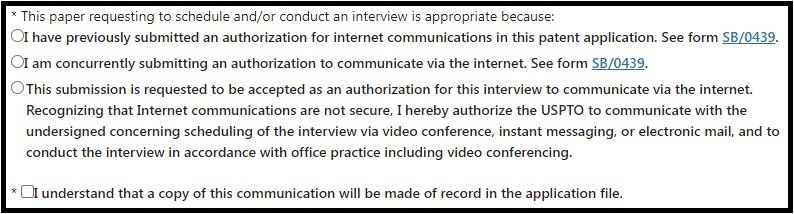
An example of the types of authorization available on the AIR form.
After you submit the form, the Examiner will contact you to schedule the interview. The Examiner will generate a video conference link using the USPTO’s WebEx platform. At the agreed-upon time, you use the link that the Examiner provides to join the video conference. For audio, you are provided with a telephone number to call. You and the Examiner have the ability to share screens, if needed, and to send proposed claim language via the chat feature.
Are there downsides? Certainly. Chief among them is that the process for requesting a video interview has a longer lag time than simply picking up the phone. Whereas you might be able to call an Examiner and have a telephone interview within the same day, the AIR form will not let you select a date that is five or fewer days away. This may not be an option for a short deadline.
Once you have requested the interview, the Examiner has two business days to respond. This compares unfavorably to making your request in a voicemail message, where the Examiner is expected to respond within twenty-four hours, adding more delay to the process.
Further, the AIR submission is not always noticed by the Examiner right away, so you may have to follow up with a phone call anyway. And, even when the Examiner sees it, they may not notice that you have requested that the conference be held by video, so a reminder may be needed as the day approaches if you do not receive the WebEx link.
Finally, in rare cases the Examiner may refuse to hold the interview by video. The USPTO’s IT infrastructure is not always perfect, and “technical difficulties” abound. What’s more, some Examiners are simply uncomfortable on video. I have always accepted the downgrade to telephone in such cases.
Despite those inconveniences, I do not find the process to be much more burdensome than scheduling a telephone interview. Give it a try for your next interview–in the worst case, you can simply fall back to the tried and true telephone. In the best case, you may find it easier to develop a productive working relationship with someone you can actually see.
Edward P. Ryan, Esq.
TUTUNJIAN & BITETTO, P.C.